WHAT SURVIVED
The signal.
The visual system, glass cube, engraving, collision of disciplines, and belief that art and engineering become more useful when they stop pretending to be separate.
ARCHIVE / PROVENANCE
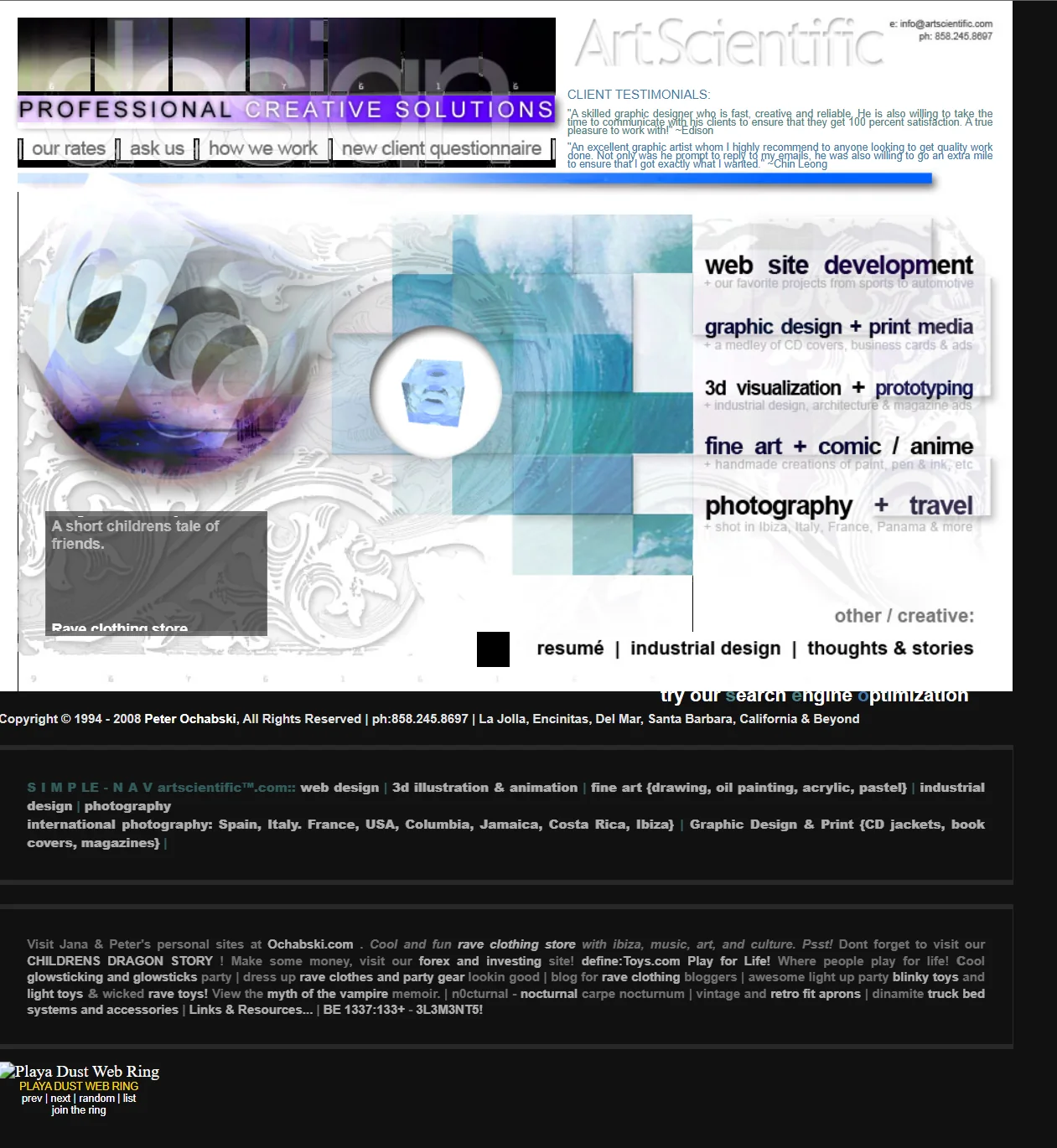
The original ArtScientific homepage was built from sliced images, table layouts, and an animated glass-cube GIF—the ordinary production language of its era.
It was difficult for modern search systems to understand, but aesthetically it already contained the full organism: Swiss grid discipline, brutalist directness, translucent wave motion, the antique Spanish printing-block engraving, technical experiments, fine art, travel, commerce, and a refusal to stay inside one category.
WHAT SURVIVED
The visual system, glass cube, engraving, collision of disciplines, and belief that art and engineering become more useful when they stop pretending to be separate.
WHAT CHANGED
Semantic HTML, responsive layout, accessible navigation, smaller image payloads, structured data, readable copy, and explicit relationships to current work.
WHAT REMAINS TRUE
Everything needs at least a seed of real truth. The archive stays visible as evidence rather than being polished into a fictional corporate origin story.
SURVIVING ORIGINAL SECTIONS
These links point to original ArtScientific pages preserved on the domain. Their layouts and language belong to their time; that is part of their value.
Early client sites, interfaces, kiosks, Flash, and commercial web work.
↗ 02Vehicles, architecture, products, instruments, robots, and spaceships.
↗ 03Painting, drawing, comic work, figure studies, fantasy, and visual experiments.
↗ 04Furniture built around reflection, proportion, glass, and cubic structure.
↗ 05Ibiza, Spain, France, Italy, the Americas, Burning Man, and more.
↗ 06CD jackets, book covers, advertising, editorial, and printed matter.
↗ 07The original manifesto, influences, color tables, ASCII codes, and glorious excess.
↗